Chipping Cleghorn Vicarage
A Murder Is AnnouncedChipping Cleghorn Vicarage serves as both a domestic refuge and an investigative hinge in the novel. It is where Jane Marple and Bunch Harmon exchange news during the crisis, where Inspector Craddock goes when Jane fails to return, and where the closing gathering reconstructs how Letitia Blacklock turned ordinary lamps, a vase, and a moment of distraction into the mechanism of a staged shooting.
Setting and household
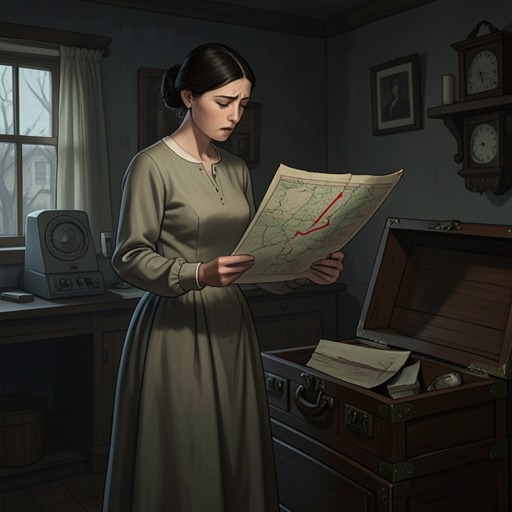
The Vicarage is the home of Bunch and the Reverend Julian Harmon. Its scenes are framed by the practical rhythms of that household rather than by the formal atmosphere of a police station: Bunch is cutting out material on the floor, Julian attends to parishioners, and Jane sits knitting by the fire. These details establish a place of ordinary work and hospitality, one that can accommodate both immediate domestic concerns and the increasingly intricate business of the investigation.
That everyday character matters to the novel’s pattern of disclosure. The Vicarage does not merely provide a neutral location for conversations. Objects and observations from the house become part of the chain by which the crime is understood, while the familiar room offers a setting in which the group can finally assemble and compare what each person has noticed.
News and divided attention
At the Vicarage gate, Bunch gives Jane a note for Miss Blacklock. Julian cannot deliver it himself because he is with a dying parishioner at Locke Hamlet; the note concerns funeral arrangements and proposes Wednesday if the inquest takes place on Tuesday. Bunch also mentions that the old Bunny has died after getting hold of poisoned aspirin intended for someone else. Her brisk departure is prompted by another urgent task: she has to get a child to hospital at once.
The exchange places the investigation alongside the ordinary claims of village life. Death, an inquest, a funeral, and a medical emergency occupy the same brief conversation, while Jane remains behind and accepts that the walk will not be too much for her. The Vicarage gate is a threshold between that passing domestic bustle and the patient attention with which Jane continues to observe the case.
The return to the Vicarage
The next afternoon, an inspector calls at the Vicarage on a dark, gusty day. Jane is seated close to the fire and knitting; Bunch is on her hands and knees, cutting fabric to a pattern. The contrast between the weather outside and the settled work indoors sharpens the house’s role as a place where visitors arrive with news and questions, while domestic activity continues around them.
Later, after Inspector Craddock has been absorbed in speculation about the pearls and realizes that Jane is missing, he goes to the Vicarage. He finds Bunch and Julian waiting anxiously. Bunch tells him that Jane has not come back. The house thus changes from a stopping place in the investigation into the point from which her absence becomes an immediate concern. Its inhabitants’ anxiety gives the detective’s search a personal as well as procedural urgency.
The closing reconstruction
The Vicarage is again the setting at the novel’s close. Jane sits in a tall armchair, Bunch is on the floor before the fire with her arms around her knees, and Julian leans forward. Craddock, smoking his pipe and drinking whisky and soda, is plainly off duty. Julia, Patrick, Edmund, and Phillipa form an outer circle as the group hears the explanation of the shooting.
Craddock reconstructs how Letitia went out just after six to shut up the ducks, let Rudi Scherz in, and gave him the mask, cloak, gloves, and torch. At 6:30, as the clock began to chime and the room’s attention turned toward it, Letitia stood near the archway with her hand on the cigarette box. Dora, devoted to her friend, kept watching her and had reported that Letitia picked up the vase of violets. Letitia had frayed a lamp cord in advance; she spilled the vase water onto the nearly bare wires and switched on the lamp, causing the wires to fuse.
Bunch recognizes that this recalls an earlier afternoon at the Vicarage, when the lamps had startled Jane. Jane explains that she had already realized there were two lamps, a pair, and that one had probably been substituted for the other during the night. Craddock adds the crucial check on the evidence: when Fletcher examined the lamp the next morning, it was in perfect order, like the others, without a frayed flex or fused wires. The Vicarage’s earlier lamp observation therefore becomes part of the explanation of how the apparent electrical accident was engineered and concealed.
Narrative significance
Across these scenes, the Vicarage holds together the novel’s contrasting scales: a child needing hospital care, the arrangements for a funeral, a missing investigator, and the careful reconstruction of murder. Its household details are not decorative pauses from the mystery. Knitting, sewing, the fire, and the lamp discussion create the ordinary texture against which a manipulated object can become suspicious, and from which Jane’s observation acquires meaning.
The ending returns the investigation to a communal room rather than leaving the solution as a private deduction. With Bunch, Julian, Craddock, and the younger guests present, the Vicarage becomes the place where scattered observations are made intelligible together. Its significance lies in that movement: from everyday shelter, through anxious waiting, to a final explanation that exposes the lethal design hidden in familiar domestic things.